

Bridal accessories checklist for Australian brides
Here is a copy-and-paste bridal accessories checklist you can use right now. Save it to your notes, print it, or share it with your maid of honour. Custom pieces need several months lead time; off-the-rack items can be purchased closer to the date. Buy shoes first so you have time to break them in. Assign the bridal bag and emergency kit to one trusted person on the day.

Complete bridal accessories checklist
Head and hair
- Veil, cape, or cape-veil hybrid
- Headpiece (headband, comb, pins, or fresh flowers)
- Hair clips or pins for touch-ups
Jewellery
- Earrings (ceremony pair + spare studs)
- Necklace (if neckline suits one)
- Bracelet or bangle
- Engagement ring and wedding band (practise the order)
- Ring box or keepsake box
Shoes
- Ceremony shoes (broken in before the day)
- Reception flats or low heels
Lingerie and underpinnings
- Strapless bra, adhesive cups, or built-in support
- Shapewear or bodysuit
- Bridal garter (toss or keepsake)
Bridal bag and emergency kit
- Clutch or small bag (pre-packed)
- Emergency kit (see full contents in Section 8)
Clothing and outerwear
- Getting-ready robe or button-down shirt
- Shawl, wrap, or jacket for weather
- Sunscreen (SPF 50+)
- Umbrella (clear or white)
- Heel stoppers for grass
Tradition
- Something old
- Something new
- Something borrowed
- Something blue
Tech and admin
- Portable phone charger
- Vendor contact list (printed copy)
- Copy of ID
- Cash and EFTPOS card
Finishing touches
- Perfume (full bottle + mini for touch-ups)
- Lip colour for touch-ups
- Spare pair of stockings or tights
Table of Contents
- What’s the difference between a veil, cape, and headpiece?
- How do you choose jewellery that works with your dress?
- How do you choose wedding shoes you can actually wear all day?
- What lingerie and shapewear do you need under a wedding dress?
- What should you pack in your bridal clutch?
- Why does your getting-ready outfit matter for photos?
- What goes in the wedding day emergency kit?
- How do you dress for Australian weather on your wedding day?
- How do you change your look from ceremony to reception?
- How do you include something old, new, borrowed, and blue?
- How do you choose and wear a wedding perfume?
- What tech and admin items do brides often forget?
- When should you buy each accessory, and what does it cost in Australia?
- How do you match accessories to your dress silhouette?
- How do you care for your veil or headpiece before and after the wedding?
- Cultural and religious bridal accessories in Australia
- Do you need a bridal mask or face covering?
- Key takeaways
- The case for keeping it simple
- Accessories available from The Wedding Garter Australia
- Useful sources and further reading
- FAQ
What’s the difference between a veil, cape, and headpiece?
Veils are the classic choice: sheer fabric that trails behind the dress and lifts for the kiss. They read beautifully in church ceremonies and formal venues where the aisle length gives the fabric room to move. Cathedral and chapel-length veils photograph well from behind, especially on A-line and ballgown silhouettes.
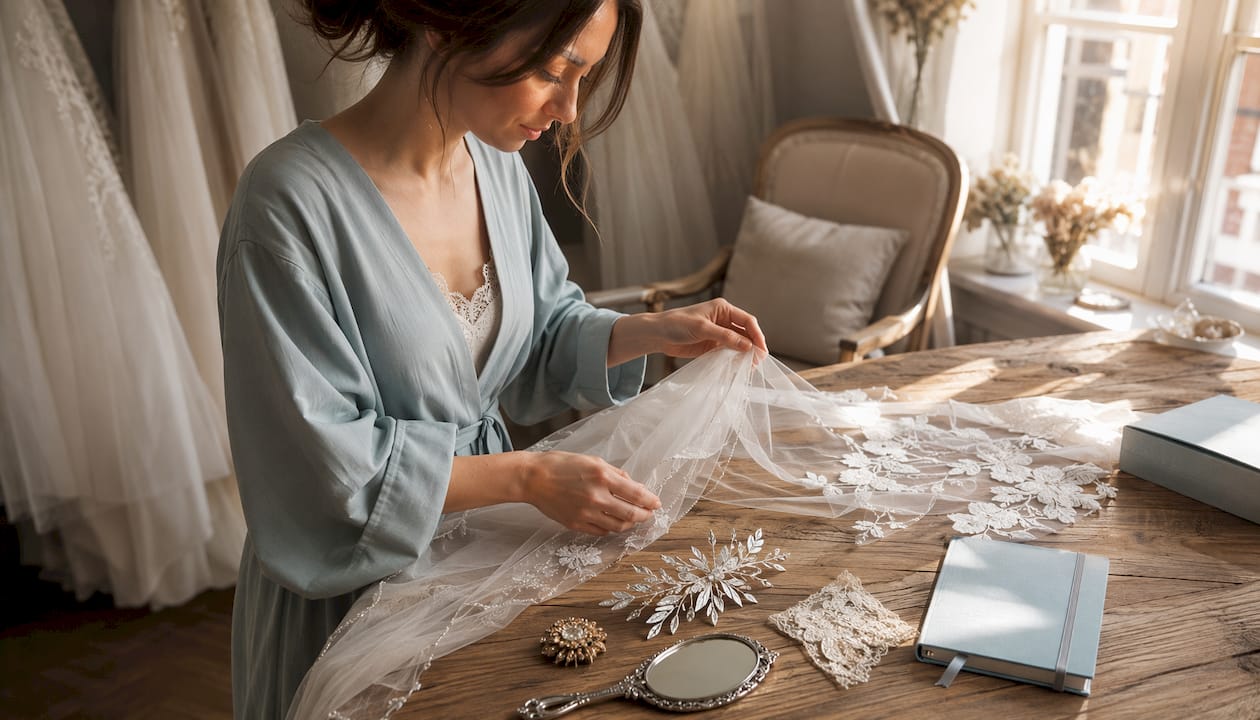
Bridal capes are more comfortable, easier to remove, and suit a wider range of dress styles. They detach quickly for the reception, which makes them practical for outdoor Australian weddings where movement matters. Cape-veil hybrids give you both: the drama of a veil for the ceremony and the ease of a cape for photos.
Quick pairing guide:
- Church or formal ballroom: cathedral veil or chapel veil
- Beach or garden: fingertip veil, cape, or fresh flower crown
- Warehouse or industrial venue: structured cape or minimal headband
- Reception dance floor: remove the veil entirely; swap to a clip or pin
Headpiece options beyond veils:
- Crystal or pearl-embellished combs
- Jewelled headbands
- Floral crowns (fresh or silk)
- Bobby pins and individual hair pins
- Tiaras (formal weddings only)
Pro Tip: Bring every headpiece to your final dress fitting and test each one with your hairstyle. What looks right on a mannequin can sit awkwardly on your actual hair texture and volume. Your stylist can also check that pins and combs are secure enough to last a full day. For detailed guidance, The Wedding Garter Australia’s bridal headpiece guide covers veil lengths, styles, and attachment methods.
How do you choose jewellery that works with your dress?
Pick one hero piece and keep everything else minimal. Over-accessorising is one of the most common bridal regrets, and it shows in photos where competing elements pull the eye away from your face and dress.
Neckline pairing rules:
- Strapless or sweetheart: statement necklace or pendant earrings, not both
- V-neck: a simple pendant that follows the neckline, or skip the necklace and wear chandelier earrings
- High neck or illusion: earrings only; a necklace will crowd the neckline
- Off-shoulder: delicate drop earrings; avoid wide necklaces that compete with the neckline detail
Rings deserve their own planning moment. Practise the order of your engagement ring and wedding band the morning of the wedding so the exchange runs smoothly. Pack a spare set of simple diamond stud earrings in the emergency kit in case an earring back is lost.
Pro Tip: Pearls are back across earrings and hair edges in 2026. If your dress has lace or embroidery detail, pearl jewellery reads as cohesive rather than competing. Crystal pieces work better against plain or satin fabrics where they catch the light cleanly.
How do you choose wedding shoes you can actually wear all day?
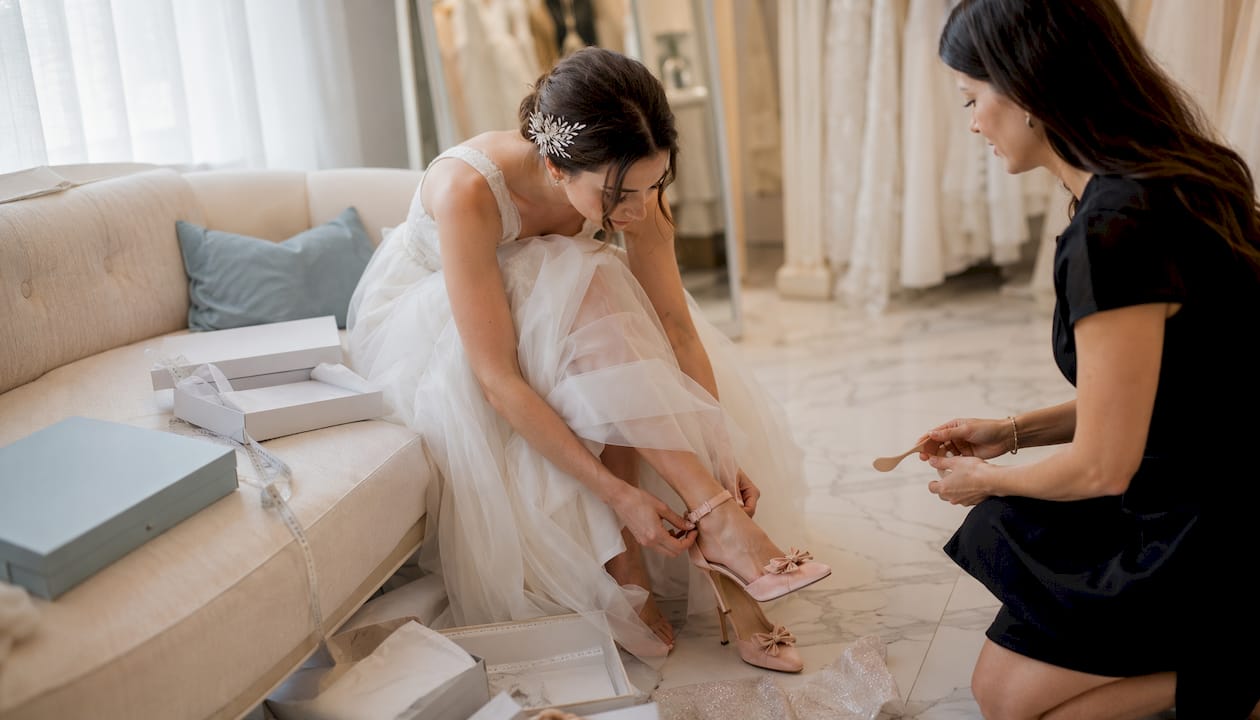
Buy shoes early and wear them regularly in the weeks before the wedding. Blisters on your wedding day are almost always caused by shoes that have not been broken in, not by the heel height.
Choosing the right heel for your venue:
- Grass or garden: block heel or wedge — stilettos sink into soft ground
- Beach or sand: flat sandal or low wedge; stilettos are unwearable on sand
- Church or ballroom tiles: any heel works; test the grip on smooth floors
- Cobblestone or gravel: low block heel or flat; narrow heels catch in gaps
Two-pair plan for the full day:
- Ceremony shoes: your statement pair, worn for photos and the aisle
- Reception shoes: comfortable flats or low heels, stored in the bridal bag or under the gift table
Sizing tip: feet swell during a long day. Buy shoes in the afternoon when your feet are at their largest, or go half a size up if you are between sizes.
Pro Tip: Test your ceremony shoes on the exact surface you will walk on. If the venue has grass, take your shoes outside and walk on a lawn. Heel stoppers (small rubber caps that fit over stiletto tips) are inexpensive and prevent sinking on soft ground. Pack a spare pair in the emergency kit.
What lingerie and shapewear do you need under a wedding dress?
The right underpinnings affect how the dress sits, how comfortable you are for ten-plus hours, and how the silhouette reads in photos. Bring every undergarment to your dress fittings so the seamstress can adjust the dress around what you will actually wear.
Pro Tip: Never buy shapewear or a strapless bra the week before the wedding. Wear your chosen pieces for a full day at home first to check for rolling, digging, or discomfort. What feels fine for an hour can become unbearable by the reception.
Undergarment options by dress type:
- Strapless gown: strapless bra with silicone grip, or adhesive cups for low backs
- Backless or low-back: adhesive bra or built-in boning; avoid standard bras
- Full skirt or ballgown: petticoat or crinoline for volume; smoothing shorts underneath
- Fitted sheath or mermaid: seamless bodysuit or high-waist smoothing shorts
- Plus-size brides: full-coverage bra with wide straps for support; look for plus-size shapewear with reinforced panels
The bridal garter:
A garter is optional, but it remains a meaningful tradition for many Australian brides. The bridal garter sits around the thigh and should sit flat under the dress without showing a line. Choose one in a stretch lace that matches your dress colour. The Wedding Garter Australia specialises in custom handmade garters, including toss garters (thrown to guests) and keepsake garters (worn for the day and kept). Order custom garters at least 4–6 months out.
Timing guidance:
- Custom shapewear or bespoke bra: order 4–6 months before the wedding
- Off-the-rack shapewear: purchase 1–2 months out, after final dress fitting
- Garter: order custom 4–6 months out; off-the-rack 1–2 months
What should you pack in your bridal clutch?
Treat the bridal clutch as a working kit, not a decorative piece. Pack it the night before and hand it to your maid of honour or a designated attendant at the start of the day. During photos, store it under the gift table or with the wedding coordinator.
Clutch packing list:
- Lip colour (the exact shade you wore for makeup)
- Blotting paper
- Tissues
- Breath mints
- Small perfume vial
- Compact mirror
- Plasters (blister size)
- Safety pins (two sizes)
- Contact lens solution and case (if applicable)
- Phone and portable charger
- Cash and EFTPOS card
- Vendor contact list
Waterproof the clutch contents by placing small items in a zip-lock bag or a fabric pouch. Sculptural clutches photograph well and double as a prop for detail shots.
Why does your getting-ready outfit matter for photos?
Getting-ready photos are part of almost every modern wedding package. What you wear while your hair and makeup are done will appear in those images, so it is worth choosing deliberately.
Pro Tip: Choose a button-down shirt or front-opening robe rather than a pullover. Pulling fabric over your head after hair and makeup is done risks smudging and disturbing your style. Satin and silk robes photograph beautifully and are a popular choice for bridal party sets.
Getting-ready outfit options:
- Satin robe (individual or matching set for the bridal party)
- Linen or muslin button-down shirt
- Personalised or embroidered robes for bridesmaids
- Silk pyjama sets
Coordinate with your bridesmaids so the getting-ready photos have a cohesive look. Matching robes or a consistent colour palette (blush, white, champagne) reads well in photos without requiring identical outfits.
What goes in the wedding day emergency kit?
Assemble the emergency kit at least one week before the wedding and assign it to one person, not the bride. The maid of honour or a trusted bridesmaid should carry it throughout the day.
| Category | Item |
|---|---|
| Fashion fixes | Fashion tape, safety pins (small and large), needle and thread (white, ivory, black) |
| Shoe care | Blister plasters, heel stoppers, spare shoe insoles |
| Stain and repair | Stain remover pen, clear nail polish (for stocking runs) |
| Cosmetics | Lip colour, powder compact, blotting paper, mascara wand |
| First aid | Pain relief tablets, antihistamine, plasters, antiseptic wipe |
| Hygiene | Deodorant, hand sanitiser, breath mints, tissues |
| Hydration | Small water bottle, electrolyte sachet |
| Sewing | Spare buttons, small scissors, double-sided tape |
Pro Tip: Store the emergency kit in a small cosmetic bag or zip pouch, not loose in a tote. Label it clearly so anyone can find what they need quickly. Keep a duplicate of the most critical items (fashion tape, pain relief, lip colour) in the bridal clutch.
How do you dress for Australian weather on your wedding day?
Australia’s climate varies sharply by region and season. A Sydney winter wedding and a Darwin dry-season wedding require completely different outerwear plans.
Outerwear options by season and venue:
- Summer outdoor: lightweight linen or chiffon wrap; breathable and won’t add bulk in photos
- Winter indoor: faux fur stole or cropped jacket for ceremony arrival photos
- Autumn garden: tailored blazer or structured cape in a neutral tone
- Beach or coastal: sheer wrap or nothing; prioritise sunscreen and a clear umbrella
Weather essentials for Australian brides:
- SPF 50+ sunscreen (apply before makeup; use a primer that contains SPF)
- Clear or white compact umbrella (doubles as a photo prop)
- Heel stoppers for grass venues
- Portable fan or cooling mist spray for summer ceremonies
Pro Tip: Match your outerwear fabric to your dress. A heavy brocade jacket over a delicate chiffon gown looks mismatched in photos. Choose outerwear in a similar weight and finish to your dress fabric: satin with satin, lace with lace-edged wraps, and so on.
How do you change your look from ceremony to reception?
Accessory swaps are the most cost-effective way to shift from ceremony elegance to reception energy without a second gown. Plan the swap in advance and brief one bridesmaid on the logistics.
Swap ideas:
- Remove the veil; add a crystal hair clip or jewelled headband
- Swap delicate stud earrings for chandelier or statement styles
- Change into reception flats stored under the gift table
- Remove the shawl or jacket; go bare-shouldered for dancing
- Add a bold lip colour for the reception entrance
Five-minute reception change:
- Designate one person (maid of honour or coordinator) to manage the swap
- Store ceremony pieces (veil, outerwear, ceremony shoes) in a labelled bag
- Have reception accessories laid out and ready before the ceremony ends
- Complete the swap in a private room or bridal suite, not in the reception hall
- Return to the reception for the grand entrance in the new look
How do you include something old, new, borrowed, and blue?
These four elements do not need to be expensive or obvious. The most meaningful versions are often the smallest.
Ideas for each:
- Something old: a piece of your grandmother’s jewellery worn as a bracelet; a small piece of lace from a family member’s dress sewn into your hem
- Something new: your wedding shoes, your garter, or a new piece of jewellery gifted by your partner
- Something borrowed: a brooch pinned inside the bouquet ribbon; a veil borrowed from a friend or family member
- Something blue: a blue ribbon sewn into the dress hem; a blue garter; a blue shoe detail or sole
For photos, consider placing small tokens where they will be captured: a blue ribbon tied around the bouquet stem, or a piece of old lace visible at the wrist.
Pro Tip: Sentimental value matters more than visibility. A tiny token sewn into the dress hem that only you know about is just as meaningful as a visible brooch. You do not need to display all four elements prominently for the tradition to count.
How do you choose and wear a wedding perfume?
Your wedding scent becomes a memory trigger. Years later, smelling that fragrance will bring the day back clearly. Choose it deliberately and test it properly before the wedding.
Pro Tip: Spray your chosen perfume on your wrist and then hold your veil fabric near it for ten minutes. Some synthetic fabrics absorb and alter fragrance. Test with your hair products too, since dry shampoo and hairspray can interact with certain scent families.
Perfume application guide:
- Apply to pulse points (wrists, neck, behind knees) after moisturiser, before getting dressed
- Spray once on the inside of the veil hem for a subtle scent that travels with movement
- Pack a mini or travel-size bottle in the clutch for a touch-up before the reception entrance
- Avoid spraying directly onto the dress fabric; oils can stain delicate materials
For photos, a small perfume bottle placed among the detail shots (ring, shoes, clutch) adds a personal styling element.
What tech and admin items do brides often forget?
These items are small, easy to overlook, and genuinely important on the day.
Tech and admin checklist:
- Portable phone charger (fully charged the night before)
- Vendor contact list (printed, not just saved on your phone)
- Copy of ID (passport or driver’s licence)
- Cash (for tips, parking, or unexpected costs)
- EFTPOS card
- Spare phone charging cable
- Earphones (for the getting-ready playlist)
Store these in a small zip pouch inside the emergency kit or bridal bag, not loose in a tote where they can be misplaced during photos.
Cultural and religious accessories: If your ceremony includes cultural or religious elements, brief your coordinator and photographer in advance. Notes for the officiant or celebrant (pronunciation guides, order of ceremony elements) can be tucked into a small envelope and handed over the morning of the wedding.
When should you buy each accessory, and what does it cost in Australia?
Custom pieces need the most lead time. Off-the-rack items are more flexible, but shoes are the exception: buy them early regardless of whether they are custom or not.
| Item | Lead time | Indicative AUD range |
|---|---|---|
| Custom veil or cape | several months | mid-range price |
| Off-the-rack veil | shorter lead time | lower price range |
| Bridal hairpiece or comb | shorter lead time | moderate price |
| Wedding shoes (ceremony) | lead time to break in | mid-range price |
| Reception flats | shorter lead time | affordable range |
| Bridal clutch | shorter lead time | moderate price |
| Shapewear or bodysuit | shorter lead time | moderate price |
| Jewellery set | moderate lead time | mid-range price |
| Custom bridal garter | several months | affordable price |
| Emergency kit contents | about a week | modest budget |
Where to splurge vs save:
- Splurge on shoes (comfort matters all day) and the hero jewellery piece
- Save on reception flats, shapewear, and emergency kit contents
- Mid-range on the clutch; it appears in photos and doubles as a prop
How do you match accessories to your dress silhouette?
Scale and proportion are the two rules that matter most. A heavily embellished ballgown needs minimal accessories; a simple sheath can carry a statement piece.
Silhouette pairing guide:
- A-line: balanced proportions suit most accessory scales; medium-length earrings and a simple necklace work well
- Sheath or column: statement earrings or a bold cuff; avoid volume at the hip or hem
- Mermaid or trumpet: keep accessories above the waist; the silhouette provides drama below
- Ballgown: minimal jewellery; the dress is the statement; a simple headpiece and stud earrings are enough
For photographer-friendly choices, avoid highly reflective hardware that creates hotspots in flash photography. Textured metals, matte finishes, and pearls photograph more cleanly than mirror-polished surfaces. A handcrafted ring box in textured wood or clean engraving photographs better than a standard pillow and is kept as a keepsake.
Accessories should support the dress, not compete with it. Select one piece that draws the eye — a statement earring, a striking headpiece, or a bold cuff — and let everything else recede. The camera will do the rest.
Pro Tip: At your final fitting, put on every accessory you plan to wear and move around: sit, stand, walk, and raise your arms. Check that nothing shifts, digs, or catches on the dress fabric. Ask your stylist to photograph you from the front, side, and back so you can see what the camera will see.
For more guidance on pairing accessories with your look, The Wedding Garter Australia’s styling guides cover silhouette-specific recommendations in detail.
How do you care for your veil or headpiece before and after the wedding?
Veils and headpieces are delicate and often stored incorrectly, which leads to creasing, yellowing, or damaged embellishments.
Before the wedding:
- Store your veil flat or loosely rolled in acid-free tissue paper, never folded
- Keep it away from direct sunlight, which yellows ivory and white fabrics
- Steam (do not iron) any creases using a garment steamer on the lowest setting, held at a distance
- Check all comb teeth and pin attachments are secure at least one week before the wedding
On the day:
- Attach the veil or headpiece last, after hair is fully styled
- Use bobby pins in a matching colour to secure combs that feel loose
- Carry two to three spare bobby pins in the clutch
After the wedding:
- Have the veil professionally cleaned before storing, especially if worn outdoors
- Store in a breathable fabric bag (not plastic) with acid-free tissue
- Keep in a cool, dry location away from humidity
Headpieces with fresh flowers should be photographed early in the day; they will not last beyond the ceremony in warm Australian conditions. Silk or dried flower alternatives hold their shape all day.
Cultural and religious bridal accessories in Australia
Australia’s multicultural wedding culture means many brides incorporate accessories from their cultural or religious background alongside Western bridal traditions.
Common cultural accessories worn by Australian brides:
- South Asian (Indian, Sri Lankan, Pakistani): maang tikka (forehead piece), jhumka earrings, bangles, and dupatta (veil or head covering); these are often layered with Western dress elements for fusion weddings
- Chinese Australian: red or gold accessories for luck; jade bangles passed through generations; some brides wear a qipao or cheongsam for the tea ceremony and a Western gown for the reception
- Greek and Italian Australian: family heirloom jewellery is common; the stefana (wedding crowns) are used in Greek Orthodox ceremonies
- Jewish Australian: the chuppah is a ceremony element, but brides may also wear a modest headcovering or veil that meets religious requirements
- Muslim Australian: hijab styling with the wedding dress is a growing area; many brides choose embellished hijab pins, crystal-edged head coverings, and modest necklines
Brief your photographer on any cultural accessories that have significance so they are captured in detail shots. For florists coordinating with cultural elements, Love You More Flower Boutique offers wedding planning guidance that includes cultural floral traditions.
Do you need a bridal mask or face covering?
Current Australian public health guidelines do not require face coverings at weddings or indoor venues as of 2026. Masks are not a standard bridal accessory at this time.
That said, some brides choose a decorative face covering for cultural or personal reasons, or for pre-wedding events. If you are planning a wedding in a venue or jurisdiction with specific health requirements, check directly with your venue and the relevant state health authority for current rules. Requirements can change, and venue policies sometimes exceed government guidelines.
For brides who want a decorative option, sheer lace face veils (blusher veils) that cover the face during the processional serve a similar aesthetic function and are a traditional bridal choice.
Key takeaways
A complete bridal accessories checklist covers head, jewellery, shoes, lingerie, bag, outerwear, tradition, tech, and finishing touches, with custom pieces ordered 4–6 months out and the emergency kit assembled one week before the wedding.
| Point | Details |
|---|---|
| Order custom pieces early | Custom veils, capes, and garters require lead time of several months; off-the-rack items can be sourced closer to the wedding. |
| Buy shoes first | Purchase ceremony shoes early and wear them regularly before the wedding to avoid blisters. |
| Choose one hero accessory | Select one statement piece and keep all other jewellery minimal for cleaner photos. |
| Plan a reception swap | Prepare a five-minute swap (veil off, statement earrings on, flats on) and brief one person to manage it. |
| The Wedding Garter Australia | Stocks crystal hair clips, pearl combs, and custom handmade garters with Australian availability for all the above. |
The case for keeping it simple
Brides who over-plan their accessories almost always regret it. The instinct to add more — another bracelet, a second headpiece option, a backup necklace — comes from anxiety, not style. What photographs well is almost always the opposite: one clear focal point, clean lines, and accessories that disappear into the overall look rather than demanding attention.
The emergency kit and the two-pair shoe plan are the two most practical decisions on this list. Both are unglamorous, both are frequently skipped, and both make a measurable difference to how the day actually feels. A bride who is comfortable in her shoes and has fashion tape within reach is a bride who can be present.
The checklist approach works because it removes decision-making from the day itself. Every item is chosen, packed, and assigned before the wedding morning. The morning of the wedding is not the time to wonder whether you packed blotting paper.
Accessories available from The Wedding Garter Australia
The Wedding Garter Australia stocks a curated range of bridal hair accessories, jewellery, garters, and lingerie, all available online with delivery across Australia from the Gold Coast.
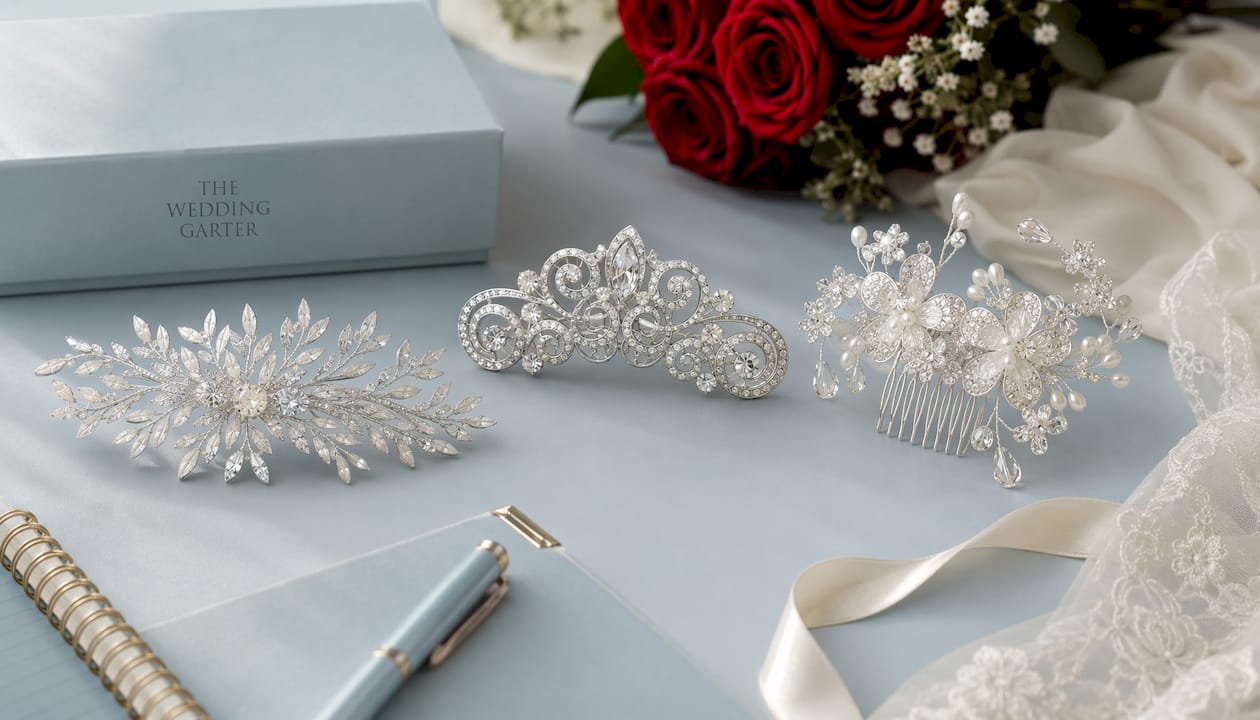
Three featured pieces worth considering for your checklist:
The Delicate Crystal Luxury Bridal Hair Clip is a clean, minimal piece that works for both ceremony styling and the reception swap. The Classic Vintage Crystal Wedding Hair Accessories suit pearl-forward styling and vintage dress silhouettes. The Bright Crystal & Pearl Bridal Hair Accessories Comb sits well in updos and half-up styles and photographs cleanly against both satin and lace.
Custom handmade garters are available with a 4–6 month lead time. Browse the full collection and check current shipping times at The Wedding Garter Australia. For a broader overview of what to look for when selecting pieces, the bridal accessories guide covers the full selection process from start to finish.
Useful sources and further reading
- Bridal Accessories Checklist 2026: What Brides Actually Need — detailed timing guidance, cape vs veil comparison, and hero-piece advice
- Bridal accessories checklist, Easy Weddings — Australian-specific emergency kit contents and clutch packing guidance
- The Ultimate Wedding Accessories Checklist, The Knot — reception swap ideas and accessory layering strategies
- Complete Wedding Accessories List for Brides and Grooms 2026, Happy Wedding App — broad checklist covering cultural accessories and style enhancers
- The Wedding Garter Australia — bridal hair accessories guide — veil, cape, and headpiece selection for Australian brides
- The Wedding Garter Australia — bridal clutch guide — packing lists and clutch style options
- Love You More Flower Boutique — wedding planning — Australian florist resource for coordinating floral hairpieces and bouquet attachments
FAQ
What are the essential bridal accessories?
The core bridal accessories are a veil or headpiece, earrings, necklace or bracelet, wedding shoes, bridal clutch, lingerie and shapewear, and a bridal garter. An emergency kit with fashion tape, safety pins, and blister plasters rounds out the practical essentials.
What are the four things a bride should have?
The traditional four are something old, something new, something borrowed, and something blue. These can be as simple as a borrowed brooch, a new garter, a blue ribbon sewn into the hem, and a piece of inherited jewellery.
What is the five things a bride needs checklist?
A practical version covers: a headpiece or veil, jewellery (earrings and one other piece), shoes (ceremony and reception), a pre-packed bridal clutch, and a fully stocked emergency kit assembled at least one week before the wedding.
When should you buy bridal accessories in Australia?
Custom pieces such as veils, capes, and handmade garters need 4–6 months lead time. Off-the-rack accessories work at 1–2 months, but shoes should be bought earlier to allow time to break them in before the wedding day.
How many accessories should a bride wear?
Choose one hero piece and keep everything else minimal. Stylists recommend two to three pieces at most: a statement earring or necklace, a bracelet or cuff, and a headpiece. More than that tends to compete in photos rather than complement the dress.
Recommended
- The Various Bridal Accessories Preferred by Brides in Australia - The Wedding Garter
- Ultimate Guide to Finding Perfect Bridal Accessories for Your Wedding – The Wedding Garter
- Finding the Best Wedding Jewellery Online in Australia - The Wedding Garter
- Rose Gold Bridal Jewellery Set Australia: The Ultimate Guide to Your – The Wedding Garter


Leave a comment