

8–20 denier bridal stockings that actually hold with a garter
Sheer thigh highs in 8 to 20 denier or silicone-lined lace stay-ups are the easiest and most photogenic choices for wearing with a wedding garter. Ultra-sheer 8 denier suits an almost invisible finish under lace gowns, while 20 denier holds up better through a full reception. The Wedding Garter Australia’s garter-compatible styles are built around exactly this fit.
TL;DR:
- Thicker 20 denier stockings with wider lace bands provide better durability and support for long wedding receptions than ultra-sheer 8 denier options.
- Proper fit depends on measuring hip, thigh, and calf circumferences rather than dress size, with sizing up recommended for between-measurement figures.
- Silicone-lined stay-up stockings eliminate clip slippage, making them ideal for brides worried about garter slippage during lively dancing or movement.
- Matching stocking color to skin tone and dress lining avoids visible mismatches in photos, especially with ivory or champagne gowns, rather than relying on fabric surface shades.
- Testing the entire hosiery and garter setup under the actual dress fabric during fittings helps prevent runs, slips, and discomfort on the wedding day.
Table of Contents
- Recommended stocking styles and finishes to pair with a wedding garter
- How do I choose the right stockings for my garter and dress?
- Step-by-step: putting on stockings and attaching them to a garter
- Sizing, care, and pre-wear checks that prevent slips and runs
- Why choose garter-compatible pieces from The Wedding Garter’s catalogue
- Best stocking styles for comfort and durability on the day
- Styling stockings and garters with different dress styles and colours
- A short buying guide: price ranges and what to expect
- What the “perfect” bridal stocking advice gets wrong
- Where to buy garters and stockings that actually work together
- Sources
- FAQ
Recommended stocking styles and finishes to pair with a wedding garter
Three hosiery styles turn up again and again in bridal wardrobes: stay-ups, thigh highs, and full suspender stockings. Each suits a different kind of wedding day.
Stay-ups grip the leg with a silicone-lined lace band, so some bridal stay-ups are designed to be worn without a garter belt at all. They’re the pick for brides who want garter tradition (the toss, the photo) without relying on the belt to hold the stocking up.
Thigh highs are the classic partner for a garter belt. They rely on suspender clips rather than silicone grip, which means they sit smoother under fitted gowns and won’t leave a compression line above the knee.
Suspender stockings, sold as a matched set with a belt, give the most secure hold of the three because the whole system is designed together rather than paired after the fact.
Denier is the other half of the decision. Bridal hosiery generally runs from ultra-sheer 8 denier through to a sturdier 20 denier, and the difference is more than just thickness:
- 8 denier looks almost bare-legged and disappears under sheer lace or tulle skirts.
- 20 denier trades a touch of transparency for strength, which matters if you’re dancing for four hours straight.
- Matte finishes read as more natural in photos; satin sheen catches light and suits a glamour-styled bridal look.
- Back seams and rhinestone details are meant to be seen, so save them for gowns with a slit, a train reveals, or a garter toss moment.
How do I choose the right stockings for my garter and dress?
Getting the fit right starts before you even try the garter on. Follow this sequence:
- Measure your leg, not your dress size. Take hip, thigh, and calf circumference, because a mismatch here is the single biggest cause of a stocking that rolls down or bags at the ankle.
- Pick denier for the occasion, not just the look. Comfort through a long reception often matters more than achieving the thinnest possible denier — plenty of brides choose 20 denier over 8 for exactly this reason.
- Match colour to your dress lining and skin tone, not the fabric’s surface shade. A warm ivory gown with a cool-toned stocking underneath can throw off the colour you see in photos.
- Test everything under the actual dress fabric. Hosiery should work as a smooth foundation that improves the silhouette without drawing attention to itself, so a fitting with the real gown catches problems a mirror alone won’t.
- Check the band and clip type against your garter belt. Wide lace bands hold better with basic hook clips; narrower bands need finer, more precise clip placement.
- Match toe style to your shoes. Reinforced toes suit closed shoes, while unreinforced or couture toes disappear under open-toe heels.
Pro Tip: Buy one size range above your usual if you’re between sizes on a chart. A slightly looser stocking held by a garter clip fixes itself; a too-tight one shows a compression line all night.
Step-by-step: putting on stockings and attaching them to a garter
Getting dressed in the right order saves you from snags, twisted seams, and last-minute panic.
- Wash your hands and remove rings before touching sheer hosiery. This alone prevents most of the small snags that show up in close-up photos.
- Roll, don’t pull. Gather the stocking down to the toe like a doughnut, then roll it up the leg gradually rather than yanking it from the top.
- Position the garter belt at your natural waist or high hip, whichever sits flat without digging in when you sit down, and square the straps so they hang evenly front and back.
- Clip below the welt or silicone band, never through the sheer leg itself. Attach the clips only once the belt is properly positioned, and take extra care aligning any back seam so it runs dead straight up the leg.
- Leave a finger’s width of slack in each strap rather than pulling them taut.
- Do a sit-stand test before you leave the fitting room or getting-ready suite, adjusting strap length until sitting doesn’t tug the stocking sideways.
Sizing, care, and pre-wear checks that prevent slips and runs
A size chart is only useful if you measure correctly first. Take hip and thigh circumference in centimetres, then match to the brand’s chart rather than guessing from your usual dress size, since hosiery sizing rarely lines up with clothing sizing.
- If you fall between two sizes, size up. A slightly loose stocking sits better under a garter clip than one that’s straining.
- Handwash in cool water with a gentle cleanser and lay flat to dry rather than tumble drying, which breaks down lace elastic fast.
- Store stockings flat or loosely rolled, never folded sharply, to avoid crease marks that show under sheer fabric.
- Do a fingernail and jewellery check the morning of the wedding. It takes ten seconds and prevents the most common cause of an unexpected run.
- Try the full stockings-and-garter combination during your final dress fitting, not the morning of the wedding, so any adjustment happens with time to spare.
Why choose garter-compatible pieces from The Wedding Garter’s catalogue
The Wedding Garter Australia builds its garters with stocking compatibility in mind from the start, rather than as an afterthought. Band width, clip spacing, and lace stretch are all sized to sit comfortably against sheer hosiery for a full day of wear.
- The Satin Bridal Garter With Floral Design pairs naturally with plain sheer thigh highs when you want the garter itself to carry the detail.
- The Bridal Garter With White Lace Applique Design suits a stocking with a subtle back seam, since the two lace textures echo without competing.
- Bundling a garter with matching bridal jewellery, such as the Vintage Art Deco Style Bridal Jewellery Set, keeps your accessory palette consistent from head to garter.
Handmade garters vary slightly piece to piece. Reach out for sizing help before ordering if you’re unsure, and check the Ultimate Wedding Garters Buying Guide for a full rundown on band and material choices.
Best stocking styles for comfort and durability on the day
Comfort and durability matter more than raw thinness once you’re factoring in eight hours of standing, sitting, and dancing. A 20 denier thigh high with a reinforced lace welt tends to outlast an 8 denier version by hours, not minutes, particularly if your reception runs long or the dance floor gets crowded.
Silicone-lined lace stay-ups solve a specific durability problem: they don’t rely on a clip staying attached, so there’s nothing to work loose as the night goes on. That makes them a strong choice for brides worried about garter slippage during a first dance or a lively reception.

For anyone wearing a garter purely for tradition (the toss, the photo) rather than functional support, a lighter 8 denier stocking under a decorative garter is fine, since the stocking isn’t doing the heavy lifting. But if the garter and stocking are working together as a genuine hold system, the sturdier 20 denier with a wider lace band is the safer bet.
Back-seam stockings need a little extra care to stay comfortable, since the seam can twist during sitting. A quick smoothing check after you sit for the ceremony or speeches keeps the line straight for photos later.
Styling stockings and garters with different dress styles and colours
A fitted lace gown calls for the most discreet hosiery you can find, generally 8 denier in a shade close to your skin tone, so nothing competes with the dress’s own texture. Ballgowns with volume give you more room to experiment, since the stocking is rarely visible until the garter toss, which means bolder colours or rhinestone seams can wait for that one moment.
Ivory and champagne gowns pair best with a stocking in a matching warm tone rather than a stark white, which can look mismatched under camera flash. Bright white gowns are the exception where a true white or very pale nude stocking works cleanly.
If your dress has a leg slit or a high-low hem, a stocking with a visible back seam or a lace-topped finish becomes part of the outfit’s design, not just a foundation layer. Pair it with a garter in a complementary colour, such as the Greta White & Blue Satin Bridal Garter, for a coordinated pop under the slit.
For a two-piece bridal look, hosiery choices get simpler because more leg is visible earlier in the day. A style like the two-piece bridal gown with a lace top from JV London suits a sheer, seamless thigh high that reads as an extension of the skirt rather than a separate garment.
A short buying guide: price ranges and what to expect
Budget bridal stockings, generally under $20 a pair, tend to use thinner lace bands and less reinforced tops, which is fine for a single wear , but risks runs if you’re not gentle. Mid-range stockings, roughly $20 to $40, usually add a wider lace welt, better elastic recovery, and sometimes a reinforced toe, which is where most brides find the best balance of cost and reliability.
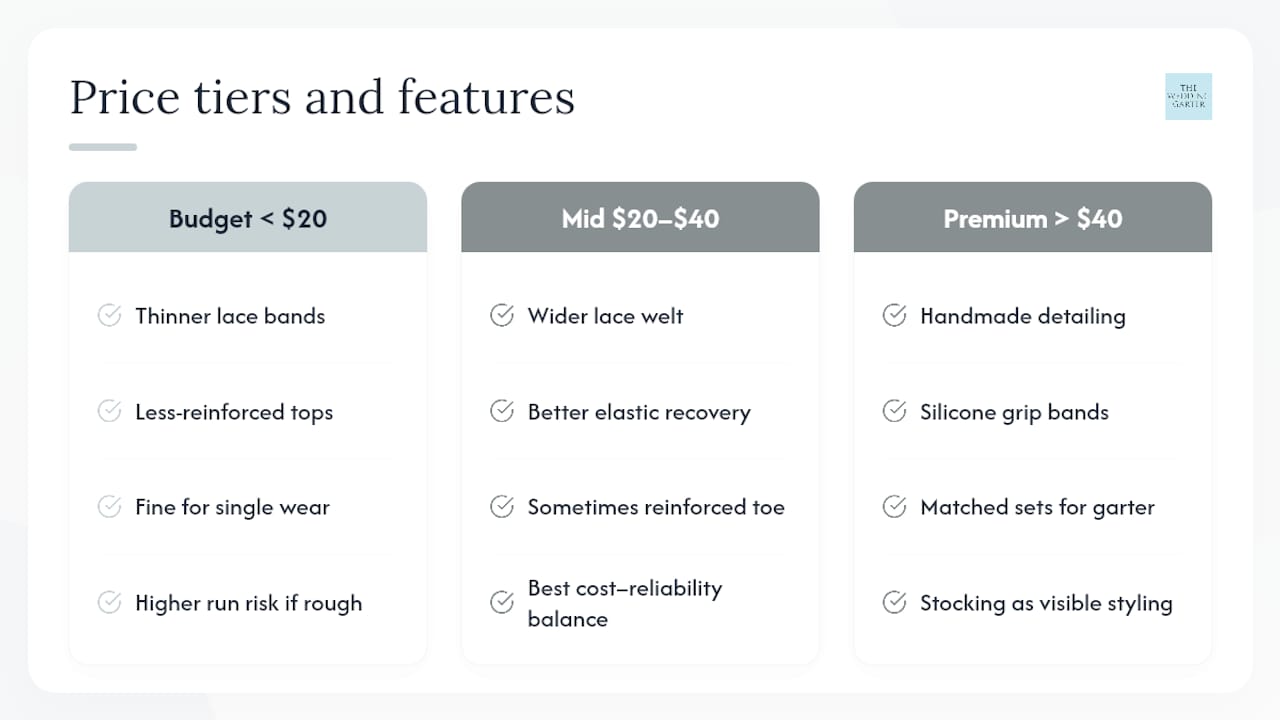
Above $40, you’re generally paying for handmade detailing, silicone grip bands on stay-ups, or matched sets designed to coordinate with a specific garter. This tier suits brides who want the stocking itself to be a visible styling element rather than a hidden layer.
Whatever budget you land on, buy at least one size up if you’re between measurements, and always order stockings early enough to test them against your actual dress at a fitting rather than relying on the size chart alone.
What the “perfect” bridal stocking advice gets wrong
Most hosiery guides treat denier and lace pattern as the whole decision, and they’re not. The bigger factor is whether the stocking has to do actual work holding itself up, or whether the garter is there purely as tradition while a silicone band or well-fitted thigh high does the real job.
Conventional advice also leans hard on “as sheer as possible,” which sounds elegant until you’re eight hours into a reception and a snag turns into a visible run down the front of your leg. A slightly heavier denier with a reinforced toe isn’t a compromise. For most weddings, it’s the more sensible default, and the thinnest option should be reserved for gowns where the stocking genuinely needs to disappear.
If there’s one thing worth prioritising over everything else, it’s the fitting-room test with your real dress and real garter, not the size chart, not the product photos. That single step catches band mismatches, colour clashes, and clip issues before they become a wedding-morning problem. Get that right first, and denier, lace pattern, and colour become far easier decisions.
— The Wedding Garter
Where to buy garters and stockings that actually work together
The Wedding Garter Australia takes the guesswork out of pairing hosiery with a garter by building each piece to work with sheer stockings from the start, so you’re not left guessing whether a band width or clip spacing will hold. Every garter in the catalogue is handmade, which means sizing questions get a real answer rather than a generic size chart.
Start with the Bridal Garter With White Lace Applique Design if you want a piece that pairs cleanly with a subtle back-seam stocking, or browse the Delicate Floral Lace Applique Ivory Bridal Set for a coordinated garter and lingerie combination. Sizing support is available if you’re unsure which fits your measurements, and every order ships from the shop’s Gold Coast base ready for a straightforward return if something isn’t right. Browse the full range of garters and matching bridal accessories and get your pairing sorted well before your final fitting.
Sources
- Wedding and Bride
- Choosing the Right Tights: Hosiery Explained - BRIDE online
- How to wear a garter belt with stockings | Journelle
FAQ
Do you wear stockings with a garter?
Yes. A garter is traditionally worn over a stocking, either a thigh high held by the garter’s clips or a stay-up worn independently with the garter placed over the top for tradition and photos.
Is it appropriate to wear stockings to a wedding?
Yes, stockings are a standard part of bridal hosiery and pair naturally with a garter, whether you choose an ultra-sheer 8 denier for a barely-there look or a sturdier 20 denier for comfort through the reception.
Do all brides need to wear a garter?
No. A garter is optional tradition rather than a requirement, and some brides skip it entirely or wear one purely for the toss while relying on silicone-lined stay-ups for actual support.
What are good thigh-high stockings to wear with a garter belt?
Look for a wide lace welt, a denier between 8 and 20 depending on how visible you want them to be, and clip-friendly band construction, such as the styles designed to pair with The Wedding Garter Australia’s handmade garters.


Leave a comment