

Long sleeve wedding dress jewellery: the neckline rule that works
For long sleeve wedding dresses, make earrings the focal point and skip bulky necklaces when the neckline is covered. Sleeves already carry the visual weight of the gown, so jewellery works best when it draws the eye to the face and hands rather than competing with lace, buttons, or beading down the arm.
Three combinations cover most sleeved gowns:
- Statement earrings paired with a slim bracelet, worn clear of the sleeve seam
- A vintage jewellery set for gowns with lace sleeves, where the metalwork echoes the lace pattern
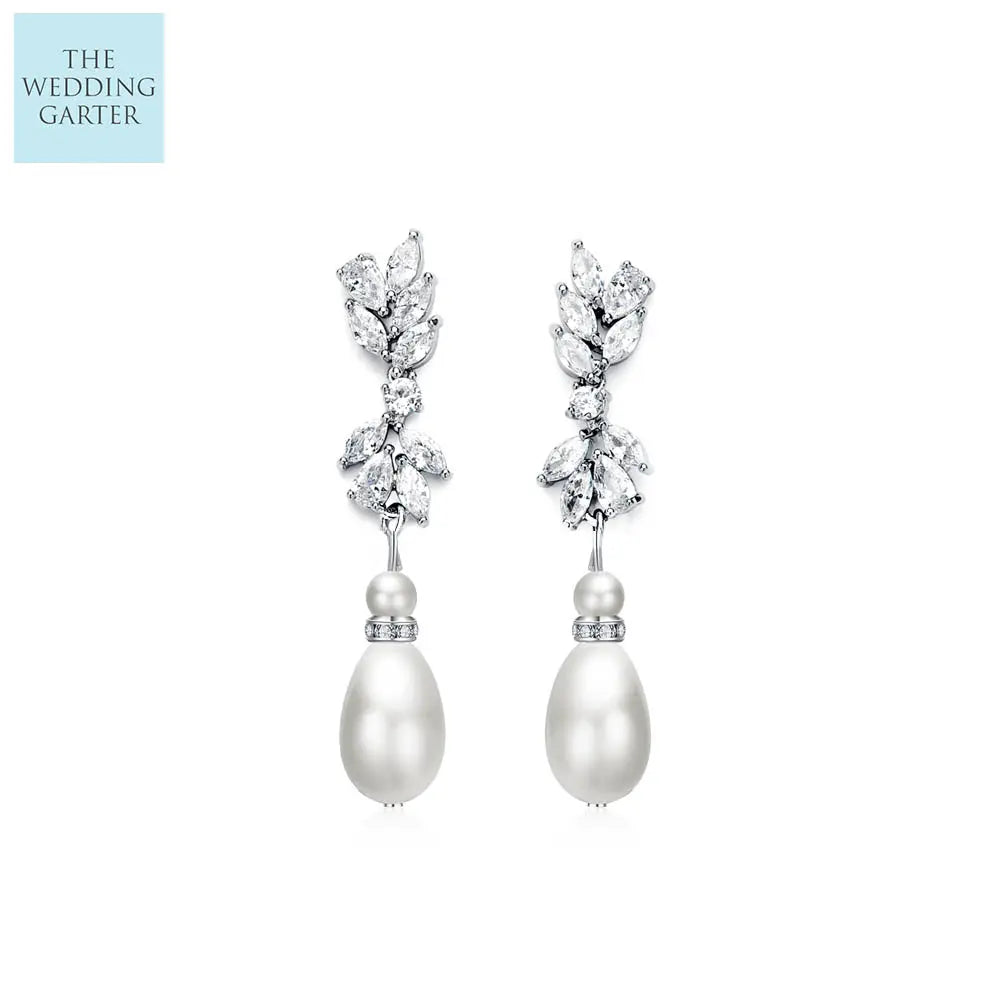
- Pearl drop earrings for a timeless, photograph-friendly finish that suits almost any sleeve style
Experts recommend skipping the necklace altogether on high or illusion necklines, letting earrings and a delicate bracelet do the work instead. The Wedding Garter Australia curates jewellery sets and hairpieces specifically for sleeved silhouettes, so brides get styling guidance alongside the pieces themselves rather than guessing what suits their gown.
Key Takeaways
Long sleeve wedding dress jewellery works best when earrings carry the focal weight and necklaces are reserved for open V, sweetheart, or scoop necklines with plain sleeves.
| Point | Details |
|---|---|
| Skip the necklace on covered necklines | High and illusion necklines rarely need one; let earrings and a hair accessory do the work. |
| Match bracelet width to sleeve fabric | Slim, low-profile closures avoid snagging lace, beading, or embellished cuffs. |
| Choose one focal piece | Pick a single statement item and keep the rest simple to avoid visual competition with sleeve detail. |
| Test jewellery in motion | Raise your arms, hug, and sit down while wearing each piece before deciding. |
| Shop with sleeve-specific pieces | The Wedding Garter Australia’s vintage, crystal, and pearl sets are built around exactly these neckline and sleeve pairings. |
Table of Contents
- Long sleeve wedding dress jewellery: why sleeves change the rules
- Neckline-by-neckline jewellery guide for sleeved gowns
- Getting earrings, bracelets and rings right
- Materials and trends suited to sleeved bridal looks
- How to test jewellery with your sleeved gown before buying
- The Wedding Garter’s approach to styling sleeved gowns
- How long sleeves and covered necklines change jewellery choices
- Matching jewellery to neckline and sleeve combinations
- Statement earrings: when to add a bracelet or ring
- What to avoid: snagging, tangling and weight on delicate sleeves
- Choosing metals and tones for your gown colour
- Hairstyles that work with your jewellery choices
- Seasonal fabric and jewellery pairing
- Jewellery styles and designers suited to sleeved gowns
- Coordinating jewellery with your veil, hairpiece and shoes
- Why sleeve type deserves more attention than neckline alone
- Curated jewellery and lingerie picks for long sleeve gowns
- Sources
- FAQ
Long sleeve wedding dress jewellery: why sleeves change the rules
A strapless gown leaves shoulders and a full neckline bare, so a necklace has room to sit and shine. Long sleeves close that space off. Whatever you wear near the neck now competes directly with sleeve fabric, cuffs, and any buttons running down the forearm, so the calculation shifts toward hands, ears, and hair.
Sleeve shape matters more than most brides expect:
- Fitted lace sleeves show through to the skin, so a delicate bracelet can layer over the lace without adding bulk.
- Bishop sleeves billow at the forearm, which makes bangles and stacked bracelets prone to sliding and catching on the fabric.
- Illusion sleeves (sheer tulle with appliqué) read as bare from a distance, so jewellery worn near the wrist becomes far more visible than it would under solid fabric.
- Puff sleeves sit high and structured, drawing attention upward, which is exactly why statement earrings work so well with this shape.
Fabric changes the equation again. Heavy beading or dense lace on the sleeve already reads as ornate in photographs, so jewellery near it should stay simple. A tulle overlay or plain satin sleeve, by contrast, has room for a slightly bolder bracelet because there’s nothing else competing for attention on that arm.
Movement is the detail most brides forget until the day itself. A bracelet that looks perfect standing still can twist, catch on a sleeve cuff, or disappear under fabric the moment you raise your arms for a bouquet toss or a dance. Ceremony photographers also shoot from a distance for most of the service, so pieces need to register clearly at range, not just up close.
Pro Tip: Test any bracelet by miming your bouquet hold, a hug, and a hand raised for a ring exchange. If it shifts, catches, or vanishes under the cuff in any of those positions, it’s not the right piece for that sleeve.
Neckline-by-neckline jewellery guide for sleeved gowns
Sleeve type sets the general rule, but the neckline underneath it decides the finer detail. Here’s how to match jewellery to the four most common pairings.
1. High or illusion necklines
Skip the necklace entirely. High necklines rarely need one, since the fabric already sits close to the throat and any pendant will fight for space against the neckline itself. Instead:
- Long drop or chandelier earrings, since they’re the only jewellery with room to move on this silhouette
- A hair accessory positioned at the crown or nape to balance the visual weight the sleeves and high neckline create together
- A single delicate bracelet, kept away from any lace cuff detail
2. Bateau or scoop necklines
These sit wider and more open than a high neckline but still cover the collarbone, so the decision depends on the sleeve itself. If the sleeve is plain (satin, crepe, simple tulle), a short necklace or collar-style piece can sit neatly along the neckline without clashing with anything on the arm. If the sleeve carries its own embellishment, lean back toward earrings and a slim bracelet, letting the sleeve be the statement.
3. V and sweetheart necklines with sleeves
This pairing gives you the most flexibility, because the open neckline creates space a necklace can actually use. A pendant that follows the V shape (rather than sitting as a flat choker) tends to look intentional rather than crowded. If you’d rather keep things simpler, a mid-length drop earring paired with coordinating studs gives the same visual balance without adding a chain to the mix. A sterling silver pendant set works particularly well here, since the pendant length can be chosen to sit just below the V point rather than across it. For gowns with a defined sweetheart line, this styling guide for sweetheart necklines breaks down proportion in more detail.
4. Off-shoulder and one-shoulder sleeves
Earrings become the primary piece here, full stop. The bare shoulder line already has visual interest, so a necklace usually just adds clutter to a neckline that’s doing its own work. A bracelet on the bare arm (rather than the sleeved one) balances the asymmetry nicely, especially if the gown has a one-shoulder cut. Avoid any necklace that would sit across or near the exposed shoulder line, since it tends to compete with the neckline instead of complementing it.
Across every neckline, one piece of advice holds: choose a single focal point and let everything else support it. Bridal stylists consistently recommend prioritising one statement piece so the jewellery reads as considered rather than layered on without a plan.
Getting earrings, bracelets and rings right
Earring length should answer to your hair, not just your neckline. Loose or half-up styles suit studs or short drops, since anything longer gets lost in the hair itself. A sleek updo, on the other hand, clears the neck and shoulders completely, which is exactly when longer drop or chandelier earrings earn their place. For gowns with a minimalist sleeve, statement earrings paired with a simple updo create the contrast the outfit needs.
Bracelets need more thought with sleeves than with any other gown style. A narrow bangle or a fine chain bracelet sits close to the wrist and clears most cuffs without issue. Wider cuffs, chunky links, or anything with an open clasp are the pieces most likely to catch on lace edges or beaded trim, and a low-profile closure reduces that snag risk considerably. If your sleeve has heavy beading right at the wrist, skip the bracelet altogether and move that jewellery budget into a ring instead. Rings photograph beautifully in ring-exchange shots and don’t fight with sleeve fabric the way a bracelet can.
Metal tone should follow the gown’s undertone, not a fixed rule. Warm ivory gowns tend to sit better with yellow or rose gold, while a stark white gown usually reads cleaner against silver or platinum tones. If you’re wearing multiple pieces, matching metal across earrings, bracelet, and any hairpiece keeps the whole look cohesive rather than mismatched.
Pro Tip: If you have sensitive skin or a nickel allergy, ask about plating before your final fitting. A piece worn for twelve hours straight (ceremony through to the last dance) needs to survive contact all day, not just look good under store lighting.
Materials and trends suited to sleeved bridal looks
Pearls remain the safest, most versatile choice for sleeved gowns, and for good reason. Pearls and vintage or art-deco styles pair especially well with lace and long sleeves, since the soft lustre echoes lace texture rather than competing with it. A vintage-inspired set with pearl and crystal detailing suits almost any lace sleeve without looking dated.
Crystals and delicate cuffs work best on sheer or illusion sleeves, where the jewellery catches light the same way the tulle does. Structured, sculptural earrings suit the opposite end of the spectrum, pairing naturally with minimalist, architectural sleeve designs that have no lace or beading of their own to contend with.
Consider the two dominant directions for 2026:
- Quiet luxury: fine chains, small studs, understated metal finishes. Suits gowns with heavy sleeve detail, since simpler jewellery avoids visual competition when a dress already carries a lot of embellishment.
- Statement pieces: bold earrings, sculptural cuffs, larger stones. This look is trending alongside quiet luxury rather than replacing it, and suits plain sleeves that need a strong finishing point.
Many brides choose quiet pieces for the ceremony and swap to something bolder for the reception, particularly with earrings, since a lighter piece can be more comfortable through hours of photographs and dancing.
How to test jewellery with your sleeved gown before buying
- Bring the actual gown, or at minimum a fabric swatch, to any jewellery fitting. Lighting and colour temperature shift how metal and stone tones read against different whites.
- Wear your hair as close to the wedding style as possible, veil included if you’re using one. Earrings that look perfect against loose hair can disappear completely under an updo.
- Photograph every option at both distance and close range. Ceremony shots are taken from metres away; reception photos are close and candid. A piece needs to hold up in both.
- Run through the motions your day will actually involve: raising your arms for a bouquet toss, hugging guests, sitting for the reception. If a bracelet snags or a necklace shifts, you’ll know before the day, not during it.
- Buy or reserve your pieces four to six weeks out, which leaves room for resizing, cleaning, or exchanging anything that doesn’t sit right on a final fitting.
- Pick one key piece and no more than two complementary accents. A statement earring, a slim bracelet, and a hair accessory is plenty for most sleeved gowns.
Pro Tip: If you’re torn between two earring styles, photograph yourself in both under indoor lighting before deciding. Screens flatten detail the same way a photographer’s lens does, so it’s a genuinely useful stand-in test.
The Wedding Garter’s approach to styling sleeved gowns
The Wedding Garter Australia is a Gold Coast based bridal accessory specialist, and sleeved gowns come up constantly in styling conversations with brides preparing for their fitting appointments. The catalogue is built around exactly the kind of neckline and sleeve pairings covered above, rather than a generic one-size-fits-all jewellery range.
A few direct matches worth knowing:
- The Vintage Art Deco Style Bridal Jewellery Set suits lace sleeves and vintage-inspired gowns, echoing the geometric detailing common in art deco lace patterns.
- The Delicate Crystal Luxury Bridal Bracelet is built slim and low profile, designed specifically not to snag sheer or fitted sleeve fabric.
- Pearl drop earrings give a classic, photograph-ready finish for brides wanting something that won’t date in ten years of anniversary photos.
Sleeve type should decide the jewellery brief before neckline does. A gown with heavy lace sleeves and a plain scoop neckline needs a completely different jewellery plan to a gown with plain satin sleeves and the same neckline, even though most styling advice treats them identically.
How long sleeves and covered necklines change jewellery choices
A covered neckline removes the one area jewellery traditionally claims. Where a strapless or plunging gown gives a necklace clear space to sit against skin, a long sleeve and high or modest neckline together leave almost nothing exposed above the collarbone. That’s the entire reason this styling category exists separately from general bridal jewellery advice.
The practical test is simple: if a necklace would sit on top of lace, buttons, or a high collar rather than against skin, skip it. Necklaces need contrast and space to register in photographs, and a covered neckline gives them neither. What’s exposed instead, your ears, wrists, and hands, becomes the new canvas.
This is why earrings do more work in sleeved gown styling than in almost any other bridal category. They sit against bare skin (the face and neck), they’re visible from every ceremony angle, and they never compete with sleeve fabric the way a necklace or heavy bracelet can. A hairpiece picks up the remaining visual interest, particularly for veiled brides, since it sits in the one area above the sleeve line that a necklace would otherwise have claimed.
The exception is any gown with an open V, sweetheart, or scoop neckline paired with sleeves. Here, there’s still skin to work with, so a necklace remains an option, just a more considered one than it would be on a strapless silhouette.
Matching jewellery to neckline and sleeve combinations
High and illusion necklines paired with sleeves need almost no neck jewellery at all. The fabric already runs close to the throat, so earrings and a hair accessory carry the whole look. Long drop or chandelier styles work best here since they have room to move against an otherwise unbroken neckline.
Bateau and scoop necklines sit in the middle ground. A plain sleeve with a scoop neckline leaves enough exposed collarbone for a short necklace or collar piece, but only if the sleeve itself carries no competing detail. The moment the sleeve has beading or lace, that space is better left for earrings alone.
V and sweetheart necklines give the most room to work with, since the neckline itself creates negative space a pendant can sit inside without looking cramped. A pendant that mirrors the V angle, rather than a straight bar or choker, tends to look deliberate. This is the one sleeve and neckline pairing where a full jewellery set, earrings, bracelet, and pendant together, can work without looking overdone.
Off-shoulder and one-shoulder sleeves flip the usual rule, since the exposed shoulder line is already the statement. Earrings stay essential, a bracelet on the bare arm adds balance, and necklaces are best left out entirely to avoid crowding a neckline that’s already asymmetric and visually busy.
Statement earrings: when to add a bracelet or ring
Statement earrings work as a standalone piece on most sleeved gowns, but knowing when to add support jewellery is what separates a considered look from an overstyled one. The general guide: if your sleeve is plain and unembellished, a bracelet or ring adds welcome balance. If the sleeve carries its own detail, the earrings can usually stand alone.
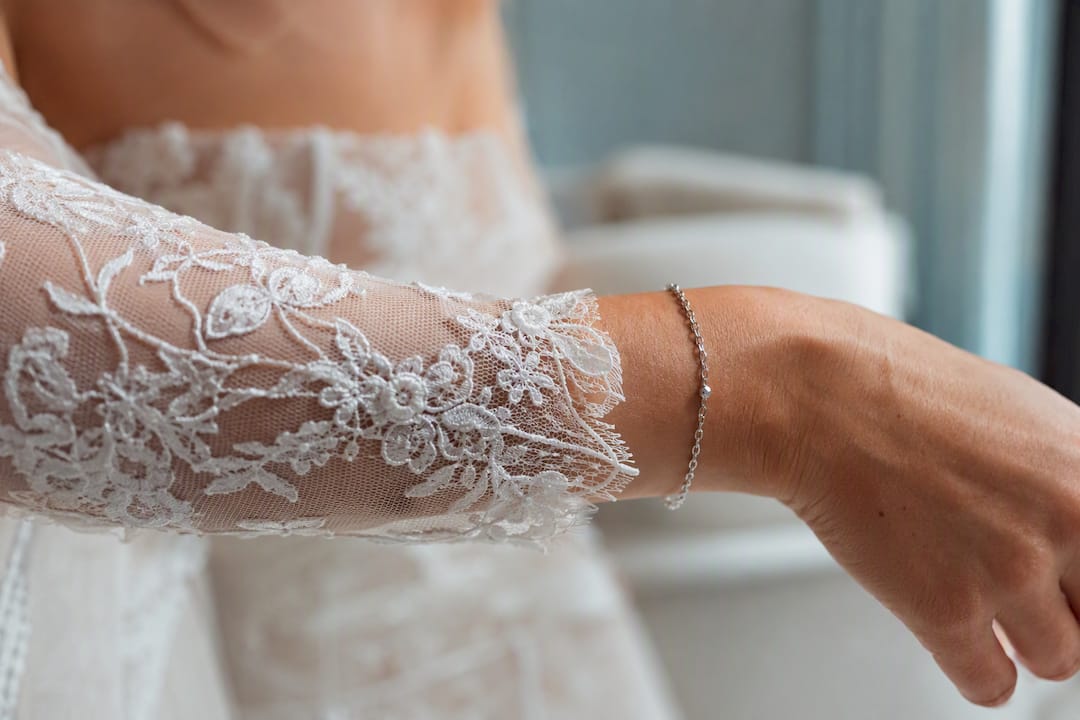
A slim bracelet pairs naturally with statement earrings when the wrist is otherwise bare, particularly on illusion or sheer sleeves where the arm is essentially visible skin. The two pieces read as a set without either one overwhelming the gown.
Rings make more sense than bracelets on gowns with fitted lace sleeves that finish at the wrist. A cuff or bangle sitting right at that seam line tends to catch and shift, while a ring has nowhere to snag and photographs just as well during the ring exchange itself.
Avoid stacking a statement earring with a heavy necklace and a bold bracelet all at once, particularly on a sleeved gown. That combination reads as cluttered even on a bare-shoulder dress, and it’s amplified further once sleeve fabric adds its own visual weight to the frame. One statement piece, one or two quiet supporting pieces, is the formula that holds up across every sleeve type discussed so far.
What to avoid: snagging, tangling and weight on delicate sleeves
Sleeved gowns introduce a practical risk that strapless dresses simply don’t have: fabric that jewellery can physically catch on. Lace appliqué, in particular, has raised edges and thread loops that open clasps, textured bracelets, and dangling charms all find a way to hook onto.
Run through this checklist before your final decision:
- Avoid open or hook-style clasps on any bracelet worn near a lace or beaded sleeve cuff, since these are the most common snag point.
- Skip heavy, dangling charm bracelets entirely on fitted or bishop sleeves, where fabric movement increases contact with the piece.
- Check earring backs are secure, since a veil or updo brushing against a loose earring back is a common cause of a lost earring on the day.
- Weigh delicate sleeve fabric honestly. Sheer tulle and fine lace can’t support a heavy cuff or oversized ring without visible strain on the fabric itself.
- Test everything seated, not just standing. Reception seating puts different pressure on wrist jewellery than standing for photos does.
The goal isn’t zero risk, since some contact between jewellery and sleeve fabric is unavoidable over a full day. The goal is choosing pieces where that contact doesn’t cause visible damage or constant readjustment.
Choosing metals and tones for your gown colour
Gown colour and embellishment tone should drive metal choice more than personal preference alone, particularly with sleeves adding another surface for metal tone to interact with.
Ivory and champagne gowns, common choices for lace sleeve styles, tend to sit better against yellow or rose gold. The warmth in both the fabric and the metal reinforces each other, rather than creating the slightly cool contrast a silver piece can produce against warm ivory tones.
Stark white gowns, more common in modern crepe or satin silhouettes, generally read cleaner against silver, white gold, or platinum. The cooler metal tone matches the crispness of a true white fabric rather than warming it unintentionally.
Beaded or crystal embellished sleeves give you the most flexibility, since clear crystal and cubic zirconia work with either warm or cool metal settings. A sterling silver and cubic zirconia jewellery set suits beaded sleeves particularly well, since the stone catches the same light the beading does without needing to match a specific metal undertone.
Mixed metal jewellery, once considered a styling mistake, is now far more accepted, provided one tone clearly dominates. If your sleeve has gold thread detailing, for instance, a mostly silver jewellery set with one small gold accent won’t clash the way it might have a decade ago.
Hairstyles that work with your jewellery choices
Hair and jewellery need to be planned together, not separately, since one directly affects how visible the other is. An updo clears the ears and neck entirely, which is exactly why longer drop earrings and statement pieces read best with this style. Nothing obstructs them, and they sit against bare skin the same way a necklace would on a strapless gown.
Loose or half up hairstyles cover part of the ear and neck, so studs or short drops make more sense than anything with length. A long chandelier earring simply disappears behind loose hair, wasting both the piece and the money spent on it.
Veils add another layer to consider. A veil attached at the crown leaves ears fully exposed, so earring choice stays flexible. A veil attached lower, closer to the nape, can brush against longer earrings throughout the day, which is worth testing during your try on session rather than discovering on the day itself.
Hair accessories, combs, pins, or a single statement clip, tend to carry more visual weight on sleeved gowns than they would on a strapless dress, simply because the sleeve has already claimed the space a necklace would otherwise occupy. A hairpiece and earrings together often complete the look on high or illusion necklines without needing anything else at all.
Seasonal fabric and jewellery pairing
Wedding season affects gown fabric choice, and fabric weight affects which jewellery actually works with it. Winter gowns tend toward heavier fabrics, velvet, brocade, thicker satin, often paired with long sleeves for warmth as much as style. These fabrics can carry slightly bolder jewellery without looking overdone, since the fabric itself already has visual weight and texture.
Summer gowns lean toward lighter fabrics: chiffon, fine tulle, and sheer lace sleeves designed for warmer weather. Delicate jewellery suits these fabrics far better than anything heavy or ornate, since a bold cuff or chunky necklace can visually overwhelm a fabric that’s deliberately light and airy.
Humidity is a practical factor worth planning around too. Warmer weather weddings mean more movement, more perspiration, and more contact between skin and jewellery over the course of the day. Plated pieces can wear faster under these conditions than solid metal, which is worth asking about if you’re marrying somewhere warm.
Cooler weddings often mean an additional layer, a shawl, jacket, or wrap, over the sleeves themselves. If you’re planning to wear one, try your jewellery on with it, since a wrap can hide a necklace or bracelet entirely for parts of the day and change which pieces actually get seen in photographs.
Jewellery styles and designers suited to sleeved gowns
Vintage and art deco inspired designs consistently suit sleeved gowns better than sleek contemporary pieces, largely because lace sleeves themselves often carry a vintage silhouette. Geometric metalwork, milgrain detailing, and pearl accents echo the kind of patterning common in heirloom style lace.
Pearl focused pieces remain a safe, versatile choice across nearly every sleeve style discussed in this guide. They photograph consistently well in both natural and flash lighting, which matters more for a wedding than almost any other jewellery consideration.
For brides after a more contemporary edge, sculptural and asymmetric earring designs suit minimalist sleeves with no lace or beading of their own. The jewellery becomes the detail the sleeve doesn’t provide.
Whichever direction you lean, choosing earrings that match your specific neckline shape matters more than following a particular designer’s aesthetic. A guide to statement earring proportion is worth a read if you’re deciding between a bold or subtle earring for the first time, since scale relative to your face and hairstyle affects the final look more than the design itself.
Coordinating jewellery with your veil, hairpiece and shoes
Jewellery doesn’t work in isolation. It sits alongside a veil, a hairpiece, and shoes that are all making their own visual statement, and a sleeved gown means there’s less bare skin to spread that visual interest across.
Start with the veil, since it’s usually the largest accessory in the mix. A cathedral or chapel length veil already commands significant visual space, which argues for simpler jewellery: studs or a short drop earring, rather than a competing statement piece. A shorter veil, like a birdcage or blusher, leaves more room for bolder earrings since there’s less fabric drawing focus elsewhere.
Hairpieces should generally match your jewellery’s metal tone rather than working as a separate decision. A crystal encrusted hairpiece like the Large Garden Design Ivory & Silver Bridal Headpiece pairs naturally with silver toned earrings and a matching bracelet, keeping the whole look cohesive from crown to wrist.
Shoes rarely need to match jewellery directly, but embellished bridal shoes with crystal or pearl detailing benefit from carrying the same accent through to your earrings or bracelet. It’s a small detail, but one that shows up clearly in full length photographs where jewellery, hem, and shoe all appear in the same frame.
Why sleeve type deserves more attention than neckline alone
Most bridal styling advice treats neckline as the only variable that matters, and that’s the gap worth calling out. A scoop neckline with plain satin sleeves and a scoop neckline with heavily beaded lace sleeves are, by conventional advice, styled identically. In practice, they need completely different jewellery.
The overlooked factor is texture, not just coverage. A sleeve with its own detail already does visual work a necklace would otherwise do, which is why the “skip the necklace on covered necklines” rule holds up so consistently across illusion, high, and heavily beaded sleeve styles. What’s underestimated is how often brides default to a full jewellery set out of habit, then find it fights with sleeve embellishment they hadn’t fully accounted for at the point of buying jewellery.
If there’s one thing to prioritise first, it’s trying jewellery against the actual sleeve fabric, not a swatch photo or a showroom mannequin. Lace catches light differently under a veil than under store lighting, and that difference changes which metal tone and earring length genuinely work. Everything else, matching hairstyles, seasonal fabric choices, coordinating with a veil, follows from getting that first decision right.
Curated jewellery and lingerie picks for long sleeve gowns
Once you know the rule (earrings first, necklaces optional, bracelets slim and snag-free) the next step is finding pieces built for exactly that brief. The Wedding Garter Australia’s collection is organised around sleeve and neckline pairings, not generic bridal categories, so the pieces below map directly to the styling advice covered throughout this guide.
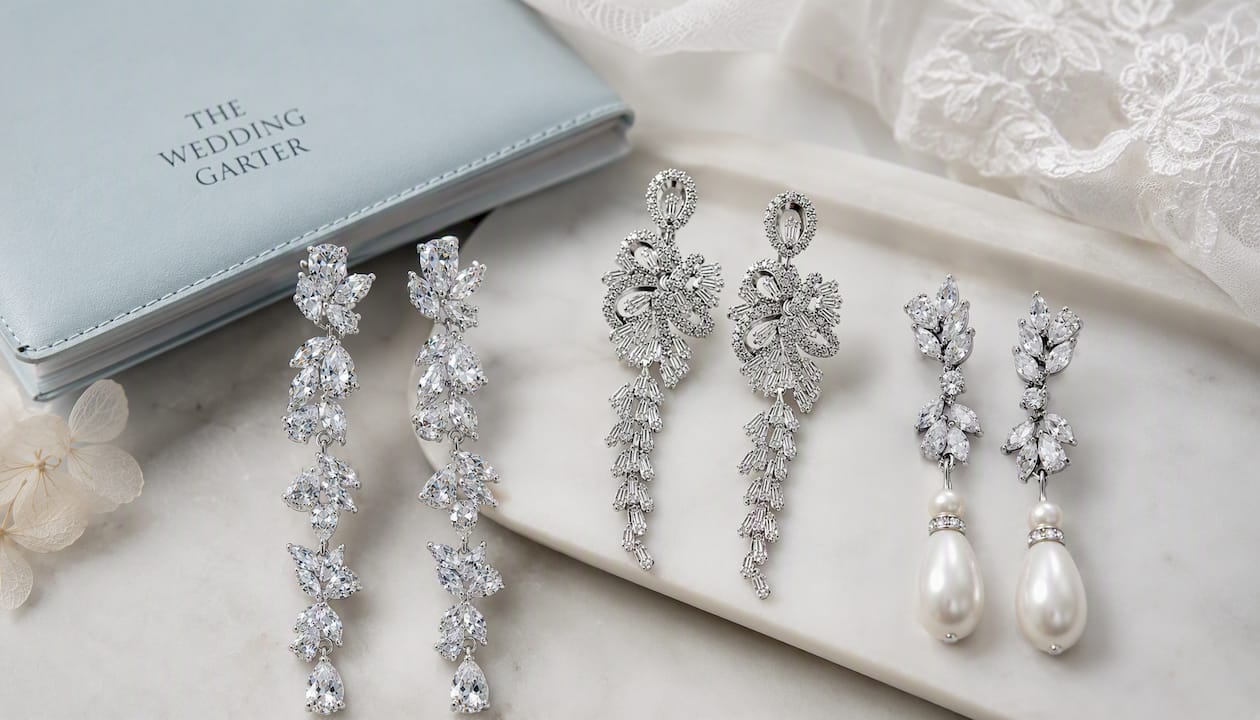
For lace sleeves and vintage silhouettes, the Vintage Art Deco Style Bridal Jewellery Set brings geometric detailing that echoes heirloom lace patterning without adding bulk near the wrist. If your sleeves are sheer or fitted, the Delicate Crystal Luxury Bridal Bracelet sits low profile and snag-free against fine fabric. Brides with a V or sweetheart neckline paired with sleeves suit the Sterling Silver Cubic Zirconia Pendant Bridal Jewellery Set, since the pendant length can follow the neckline without crowding it. Beneath the gown, pieces like the Luxury White Lace Lingerie Chemise and the Delicate Crystal Luxury Bridal Hair Clip round out the look from veil to hem, while a Vintage Ivory Lace & Satin Bridal Garter finishes the details no one sees until the reception.
Try these pieces at home against your actual gown fabric, or bring the gown into a fitting, before committing. The full jewellery and accessory range sits at The Wedding Garter Australia, organised by style so you can shop by the exact look your sleeve and neckline call for.
Sources
- How to choose what jewelry to wear with your wedding dress
- The best bridal jewelry for every wedding dress neckline
- What jewelry to wear with your wedding dress
- Bridal accessories trends
FAQ
What jewellery should I wear with a long sleeve wedding dress?
Favour statement earrings and a slim bracelet, and skip the necklace if the neckline is high or covered. If your sleeves have their own lace or beaded detail, keep other jewellery simple so it doesn’t compete.
What jewellery works with an off-the-shoulder wedding dress?
Earrings become the primary piece, since the exposed shoulder line is already the visual focus. A bracelet on the bare arm adds balance, but avoid necklaces that crowd the neckline.
What jewellery should a bride generally wear?
Most bridal stylists recommend choosing one statement piece and letting everything else support it, rather than wearing a full matching set of earrings, necklace, and bracelet at once. The right combination depends on neckline, sleeve style, and how much detail the gown already carries.
How do I accessorise a long sleeve wedding dress overall?
Start with your neckline and sleeve fabric, then choose one focal jewellery piece, coordinate your hairpiece and veil to the same metal tone, and test everything against the actual gown before the wedding day. The Wedding Garter Australia’s neckline-specific collections make that matching process considerably easier than shopping generic jewellery ranges.
Recommended
- What Jewellery to Wear With a Sweetheart Neckline Wedding Dress: Your – The Wedding Garter
- Best Bridal Jewellery for a VNeck Gown: The Ultimate 2026 Style Guide – The Wedding Garter
- Best necklace for strapless wedding dress: brides’ guide – The Wedding Garter
- The Best Bridal Earrings Style For Every Dress Neckline - The – The Wedding Garter


